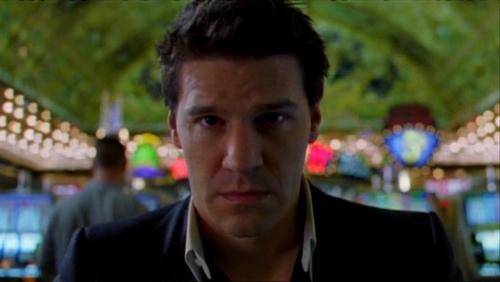
Angel, like Buffy the Vampire Slayer, as well as so many other good shows throughout television history, still occasionally suffered from the odd episode that was clearly filler and failed to really connect with fans. “The House Always Wins,” the third episode of season 4, was one such installment, but it has one particular plot device that still speaks to me today, which I feel somewhat redeems what is generally regarded as an uneven, bland episode.
The Spin-and-Win, a gambling wheel rigged by the episode’s villain, the casino owner Lee DeMarco, is only accessible by guests chosen by the casino. DeMarco uses Lorne’s ability to read people’s auras and see their futures, and with this information, chooses the ones with the most profitable destinies. They are given a special gambling chip to play the Spin-and-Win, with a million-dollar prize as the lure. When his mark takes the chip, it is imprinted with that person’s future destiny, and when they inevitably lose, they are left virtually mindless, their destiny taken away along with their ambition, and they spend the rest of their lives in a dull haze, listlessly spinning away quarters in the casino’s slot machine.
Most fans feel this is a pretty heavy handed attempt to equate gambling with throwing away one’s future, and while that’s not a completely off-kilter supposition, it’s one I never really connected with gambling in spite of the context. The Spin-and-Win, along with its devious ‘destiny chip’ component, may have existed in a casino, and been in the purview of gamblers and those who loved games of chance, but to me the symbolism went a lot deeper. The trap that the Spin-and-Win represented could take any form, and entrap just about anyone, as long as they obsessed enough about it.
Yesterday I wrote about creation vs. consumption, and how Stephen King’s It both represented that struggle and how it’s helped inspire me to throw off (at least for now) the trappings of consumption so I can create. The image of this thing, the Spin-and-Win, from this episode of Angel, was another of the primary motivators that came to my mind’s eye as I came to this realization. The Spin-and-Win, in my estimation, could be anything to anyone, much like It could take on the form of anything that its victims feared. It wasn’t just about gambling, although I suppose my vice of gaming could easily be argued to have many parallels to that pastime.
For me, the Spin-and-Win represents video games. For someone who loves food too much, the Spin-and-Win represents food. For others, it could be sex, alcohol, television, movies, music. More broadly, the Spin-and-Win represent excess, the overindulgence of an otherwise harmless vice that creeps into your life and steals from you. Time, energy, devotion to otherwise creative or self-improving pursuits. It’s an easy retreat into something that’s comforting, but otherwise and ultimately, pointless.
I admit, “The House Always Wins” is not a great episode of Angel, though I still enjoyed it just fine. But the idea of someone throwing away their destiny because they see an easy (but rigged and unattainable) win in front of them is a powerful one that has stuck with me through the years. It’s always been there, in the back of my thoughts, and I’ve at times wondered why that particular form of that vice stuck when there have certainly been others that may have been more apt.
Now I know why, and I’m sending up that image to pull free of my own tendency to put of creating–writing–with something easy to consume–in this case, video games.
It may not be the prettiest or most eloquent way to break free, but so far it seems to be working out well for me.










 Spidey Librarian