
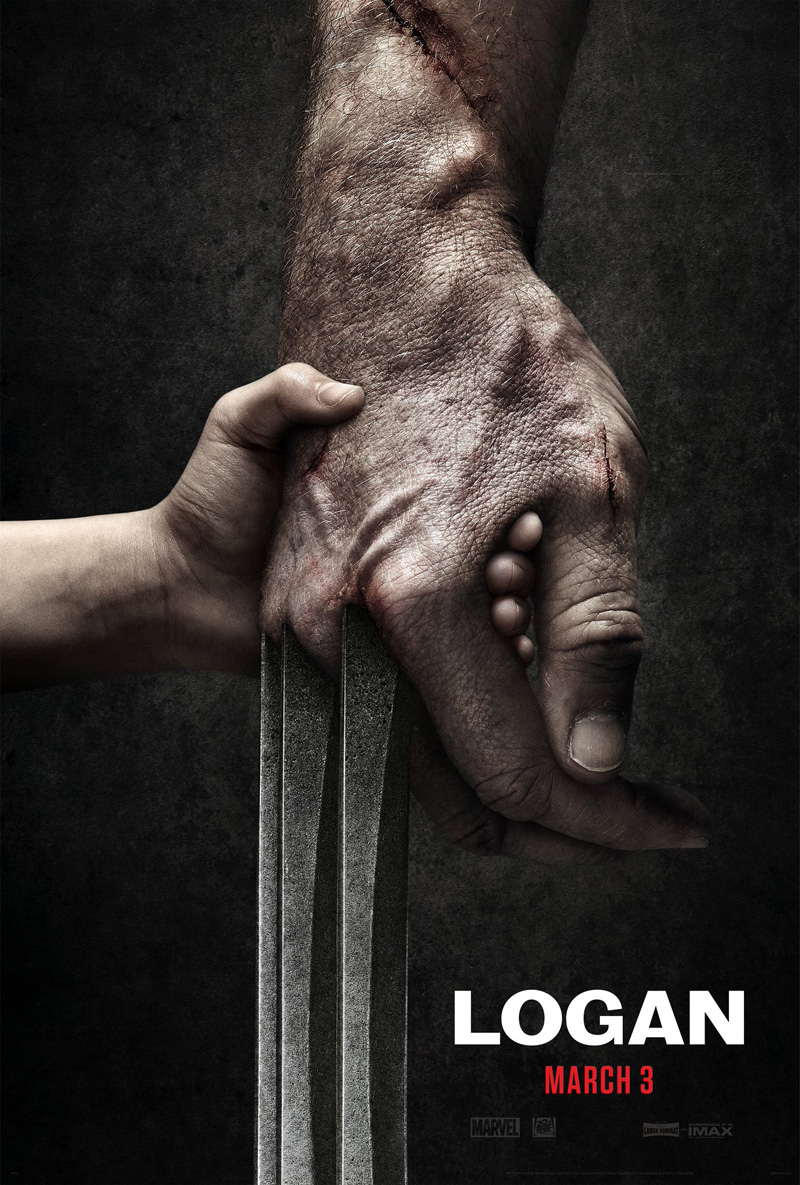
When Agents of S.H.I.E.L.D. walloped its viewers with the double whammy of the cliffhanger ending to the February 21 episode “Self Control” AND the revelation that it wouldn’t be resolved for over a month, until April 4, there were veritable howls of frustration from fans. I immediately consoled myself with the idea that the adjoining month of March would provide me with enough fresh Marvel media content to hold me over. Logan, which has been described as Hugh Jackman’s final performance as Wolverine, would hit theaters on March 3, and Iron Fist would drop on Netflix 2 weeks later on the 17th.
I’ve loved all of the Netflix MCU properties thus far, and I’m expecting similarly great things from Iron Fist, casting controversies aside. But I can also say, now that I’ve finally gotten around to seeing it, that the non-MCU Logan has proven to be a noteworthy swan song for Hugh Jackman, whose portrayal of Wolverine/Logan/James Howlett has been lauded and beloved by fans and moviegoers the world over since he donned the adamantium claws in 2000’s blockbuster film X-Men. While Fox has certainly had a hit and miss track record with its Marvel properties, there’s no doubt that Logan will be remembered as one of the biggest hits.
What follows is a SPOILER-FILLED review of Logan. PLEASE DO NOT READ ANY FURTHER if you want to remain unspoiled for this film.
The X-Men series of films, like the comics, have never been shy about portraying the future as bleak, apocalyptic, and altogether terrible for its heroes. What Logan does that’s both unexpected and successful with this trope is live in that future,facing down both its bleakness and the accompanying fallout, which only gets worse. It’s a powerful slap to the viewer’s sensibilities to learn that it’s years removed from the last X-Men film, that the future is dark and foreboding, and that things are not going to be changed by a leap back in time to alter the past. The X-Men are gone, Logan is in hiding, and mutants have all but gone extinct, with none having been born in decades.
 This setup makes for a dark, gritty, and often violent story that only gets darker as the exposition continues. An older Charles Xavier (the ever-venerable Patrick Stewart) is now prone to seizures, which cause him to psychically lash out to anyone nearby during his episodes, and Logan has to keep him both isolated and medicated, and works as a driver to try to make ends meet. When a woman approaches him with a request for help, he is soon pulled into a chase that involves him far more intimately than he could have imagined. Pursued by a ruthless agency, Logan and Xavier embark on a road trip that may spell the end for them, even as it delivers hope to a new generation of mutants.
One of the most gratifying, yet simultaneously saddening elements to this film is its unflinching exploration of how these characters have aged. The film is set in 2029, which–if you count the X-Men film as being set in the year 2000–means that nearly thirty years have passed since Logan and Xavier met at the Institute. And time has not been kind to the X-Men. In addition to the lack of new mutants being born, and the talk of them simply being a near non-issue in this world, there are oblique references to a “Westchester incident,” which may or may not have involved Xavier. This paints a grim picture of what may have happened to the rest of the X-Men, and though it is never directly addressed, Xavier clearly remains haunted by it, effectively leaving viewers’ imaginations to fill in the details while also making them almost too afraid to ask for the details. It’s a big narrative risk to take, but one that pays off nicely to the story’s tone.
 Logan has aged, in several notable ways. He clearly looks older now, which makes sense given that Hugh Jackman himself has aged in the last 17 years. But there’s more: his healing factor is no longer working the way it used to, and appears to be slowly failing him. He has wounds that no longer heal, he looks older and more beaten-down, and he’s overall in a darker place. He can’t just slash his way through a fight anymore and expect to self-patch up afterwards. He’s playing reluctant nursemaid to Xavier, and the two have clearly had their differences during this time, even if it’s clear they still care for one another.
 Of course, the most obvious way in which Logan has aged is embodied in the character of Laura (played perfectly by Dafne Keen), who anyone who’s familiar with the comics will know is X-23, a.k.a. Laura Kinney, a.k.a. a clone of Wolverine. She looks like him, acts like him, and has his power sets and gifts, in virtually every way identical. When it’s confirmed that she was indeed cloned–well, actually birthed in the film–using his genetic material, Logan has to deal with the fact that, like it or not, he is responsible for her–something he is clearly not eager to do.
Another strong aspect of this story is, unsurprisingly, a tragic one. It’s obvious that Logan pushes people away out of fear that anyone he cares about dying because they happen to be around him. This is no more perfectly portrayed than in the scene where Logan, Laura, and Xavier help out a family in the aftermath of a near-fatal highway accident. After helping them round up the horses that got loose from the family’s trailer, they invite the mutants to their home for dinner as thanks. They have a nice, family-style dinner with their new friends, including several moments of humor and warmth, before their pursuers catch up with them. In the confusion and chaos that follows, every member of that family is killed, and the father clearly knows it was because they befriended Logan and his companions.
 The importance of relationships is also a strong theme in Logan. Logan and Xavier. Logan and Laura. Laura and Gabriela (Orange Is the New Black‘s Elizabeth Rodriguez), the nurse who died to get her to Logan. Laura and Xavier. There are genetic obligations, there are relationships that are built on the foundation of a long association and trust, and there are familial relationships. It’s telling that Logan leaves Laura behind when they first come under assault, grabbing Xavier and saying, “She’s not our problem.” Clearly this changes as he learns about his connection to Laura from Gabriela’s recording and Xavier’s prodding, but the real sense of family between those two doesn’t come through–at least from Logan–until nearly the film’s end.
And it is that relationship that is used to violent effect upon Xavier, as a cloned, younger replica of Logan sneaks up on him and mortally wounds him before he can take action to defend himself. It ends up being the first of several hard to watch deaths in the film, another notable feature Logan brings to the table. And while it’s hard to watch Xavier die in front of Logan during the action (I mean, really, it was), the emotional wallop comes afterwards, when Logan has buried him, and can’t come up with anything to say, plodding and stumbling through just a few words about having “water nearby” before finally giving up.
One fairly amusing theme in all of this grit involves communication, namely how Laura communicates, particularly with Logan. Through out the first two thirds of the movie, she is silent, or at least wordless, only giving voice to primal screams during fights. Xavier can communicate with her telepathically, and relays her thoughts to Logan, but he also speaks back to her in Spanish, apparently how Laura understands language. After Xavier’s death, Laura starts speaking to Logan–in Spanish. Which is hilarious, as Logan clearly doesn’t understand a lick of Spanish. When she finally does start speaking to him in English, the end of the movie is nearly upon viewers.
Which does set up the most emotionally impactful–if not terribly original–moment of the film. In most films where there are distance issues between a parent and child, one of the most powerful moments is when the child finally utters the word, “Mom” or “Dad” for the first time. After Logan‘s high-stakes, action packed finale, we have a mortally wounded Logan, fading and dying despite Laura’s best efforts to save him. She finally breaks down and calls him “Daddy” just before he passes. And even though you see the moment coming a mile away, even though you know this is a trick verging on outright manipulation, you can’t help but feel the power of that word when Laura speaks it.
There are plenty of other details I’m leaving out, but these are the most memorable ones I could recall from seeing Logan. It’s a violent movie, with plenty of blood and gore. It’s dark. It’s gritty and hard to watch. People and characters you care for will suffer, and die. It’s fierce. It’s cutthroat, literally, in places. It’s visceral. And it’s quite possibly the best film that stars Hugh Jackman’s Wolverine–and I include the X-Men films in that group. It’s an excellent swan song for a beloved actor/character pairing that filmgoers and fans have loved for the last 17 years.
Onto Valhalla with you, movie Wolverine. And to Hugh Jackman: well done, good sir. Very well done indeed.
And as this is Patrick Stewart’s final outing with Charles Xavier, I will simply say thank you. You were an amazing Professor X, as well as a wonderful Captain Picard. I can’t wait to see what you do next.
 Agents of S.H.I.E.L.D. got off to a bumpy, if charming start, banking on the likability of its characters as much as Phil Coulson’s “connection” to the films. People tuned out after a couple of episodes, and the main complaint at the time seemed to be its lack of utilizing flashy, powered characters from the comics that weren’t being used in the films. I remember seeing more than a few commenters upset that Mike Peterson didn’t turn out to be Luke Cage during the first episode, for instance.
 Then, those of us who did stick around learned something important about season 1: it was, by necessity, hamstrung on what it could explore in relation to the movie studio to which it was connected. Even so, there were glimpses and flashes of what the show could be in some of the earlier episodes, such as “Eye Spy.” When Captain America: Winter Soldier blew the lid off the first season, Agents of S.H.I.E.L.D. became a lot stronger and more action-packed in its storytelling, and I would argue has maintained a compelling narrative ever since.
 On the other hand, there are plenty of strengths to this season. Daisy (not Skye anymore!) meets and ultimately has conflicts with both of her parents, leading to a final showdown that is both heartbreaking and memorable. Bobbi Morse (Mockingbird!) is introduced, and is wonderfully played by Adrianne Palicki, as is Nick Blood’s character Lance Hunter. Mack and the “other, real S.H.I.E.L.D.” storyline was also memorable, particularly as well as actor Henry Simmons played his scenes. And the Inhumans situation is brought to a head at the end of the season, setting up a good portion of the themes in season 3.
 Ward’s “evolution” into the character Maveth made for a legitimately world-ending threat, pressing S.H.I.E.L.D. to its limits as they finally broke out the Secret Warriors. Several excellent Inhuman characters comprised this team, including Joey Gutierrez, who can melt metals, and Elena Rodriguez, a speedster. When that threat is finally taken care of, Hydra seems to finally be obliterated, and the focus of the show may seem to finally shift from Inhumans to… Ghost Rider?
 Anyone who knows me can tell you that I’m a big fan of the MCU that Marvel Studios started back in 2008 with Iron Man and The Incredible Hulk. I love the interconnected nature of the movies, and how they reinforced the notion that these were characters whose actions would affect the plots and developments of others that came along. It was a brilliant way to conceptualize and bring together a movie franchise, and it was so uniquely a Marvel opportunity, that I knew their film The Avengers was going to be a huge hit, even as far back as Iron Man, when it was only being hinted at.
 With the ever-present phrase “It’s all connected” a seeming mantra of the entire universe, it seemed a no-brainer that there would be plenty of connections, however tenuous, between the films and the shows that emerged on ABC and Netflix. And as far as Agents of S.H.I.E.L.D. has been concerned, they’ve made plenty of references to the films to show they’re connected, from having some of their stars (Thor‘s Jamie Alexander, The Avengers‘ Cobie Smulders and Samuel L. Jackson, and Captain America: The First Avenger‘s Haley Atwell jump quickest to mind) appear on the show, to having episodes and plot arcs made in direct response to the events of the films. Netflix shows Daredevil and Jessica Jones have made small, oblique, blink-and-you’ll-miss-them references to the films, but thus far have mostly kept to themselves in terms of really connecting to anything else.
 Come on, Marvel Studios. Would it really be that hard for you to do that little?
 Spidey Librarian