October has been an extremely enjoyable month for me so far, and not just because I’ve gotten such good responses to my daily two-sentence horror stories. With the weather changing, the temperatures dropping, and the sights of Halloween costumes just on the horizon, this month has felt like a month of transition, relaxation, and rejuvenation. And while I’ve had a lot of fun getting these two-sentence horror stories out in front of people, it would be easy to forget that this blog is not just for short, terror-inducing content. So I figured I’d talk about another topic I like, while still keeping to the horror theme: video games.
I do enjoy my video games, and while I don’t consider myself a power gamer by any stretch of the imagination–I simply can’t devote the time and energy needed to any one game like that anymore, much less several of them–I do consider video games an integral part of my regular relaxation. They are to me an excellent way to unwind, forget about the trials and tribulations of the regular grind of the workday, and immerse yourself in a virtual world. They can also be a time sink and occasional money sink, but I like to think I’ve become a little more savvy about navigating those particular minefields, at least most of the time.
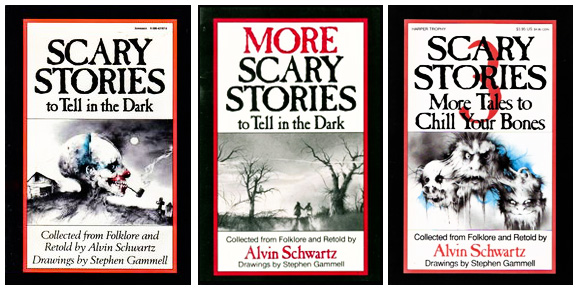
 There also exists a cute little fascination I have with horror stories and the creepy and macabre. I love reading creepypastas and listening to YouTube videos about them, and I have my own copy of the Scary Stories Treasury, the collection of all three volumes of Alvin Schwartz’s Scary Stories to Tell In the Dark books (the Gammell illustrated ones, thank you very much). I even enjoy and revere the old slasher horror films that got started in the 70s and 80s–you know, Jason Voorhees, Freddy Krueger, Michael Myers, Leatherface; those types of movies. You’d think this particular obsession would dovetail nicely with my love of video games and send me clamoring to get my hands on some interactive scares, thrills, and chills.
But the thing is, I really don’t play horror video games.
Don’t get me wrong, I do enjoy them. I actually do have a couple of horror games on my Steam account that I have played, and still do (though instances of doing so are few and far between), and I’m happy to watch particular Twitch streamers and YouTube stars do playthroughs of the latest squick-filled story. But personally, there’s a marked difference between reading a scary story and experiencing one in real-time through a video game. You get drawn in and manipulated in a way that, for better or worse, can’t often be matched by the mediums of film or prose.
I’ll give you a couple of situations as an example.
 I listened to/watched a YouTube video that contained, among other creepypasta stories, the story of Molly the Dolly. It was extremely well narrated, and the jumpy, jagged animation, though fairly simple, was very effective in making the story stick to my memory. After I was done with that list, and ready to go to bed, I remember being a little creeped out by the memory of that story, and had some trouble sleeping, but overall was able to get a full night’s rest. An effectively told story, that I thought would have worked in Scary Stories to Tell In the Dark if it were still going, kept me up a little, but didn’t scare me awake.
Now for the video games.
 A couple years ago, on Halloween, I decided to try my hand at a couple of horror games–Slender: the Arrival, and Five Nights at Freddy’s, for the record. I handed out candy that night, and then turned out the lights, fired up my computer, and downloaded and played them. I gave each several hours worth of attention, enduring both the uncertainty of where Slenderman would appear and short out my camera view, and the firsthand apprehension (and explosion of terror) of when and where one of those damn animatronic things would pop out and get me–yay, jump scares. By the time I was done playing, I knew I wouldn’t be sleeping that night. Thank goodness I didn’t have to work the next morning.
So, simply put, I like sleeping, and the horror games I have played have made that difficult. True, I may become desensitized to them with more exposure. But in the meantime, I just want to sleep.
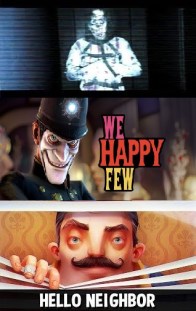 That’s not to say I patently avoid horror games. I’ve been intrigued by games like Night Terrors, a “Pokemon GO for horror fans,” as touted by some; We Happy Few, which looks like it’s a psychedelic balance of managing your meds enough to blend into the horrific, mask-wearing community without getting consumed by them; and Hello Neighbor, a game that apparently tracks your habits so the AI can design traps for the way you think. All look like they’re worth a play, and I may even do so if I’m feeling particularly brave.
But for the most part, I’m content to keep the horror gaming genre at arms length. I like my scares, and I like my video games, but I think combining the two would not work for me on a firsthand basis, at least not for a while. I’ll be happy to watch them as let’s plays, and even occasionally dabble in one once in a while, but for now at least, I believe I’ll be happiest just watching or hearing about them.
At least then I can laugh at the scare the damn things give me.
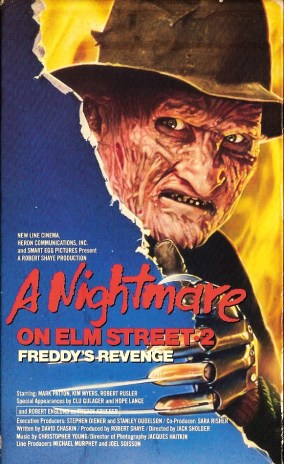 I don’t think it helps that my first exposure to these films was A Nightmare on Elm Street 2: Freddy’s Revenge, where Freddy seemed particularly more vicious than I’d see in the later films (though the first classic one was also a pretty good horror film on its own thanks to Robert Englund’s performance). Not only was he killing people in their dreams once they fell asleep–a terrifying enough premise all on its own–but he was also possessing one particular teen-aged character once he fell asleep in order to do it. In any case, the terrifying, claw-gloved antagonist of this series would go a long way in making sure I resisted the urge to fall asleep as much as possible for many years. It probably helps explain why I’m such an effortless night-owl by default.I’d thought I wouldn’t be able to take Freddy seriously when they made him more of a clownish killer in the later Nightmare movies, but Wes Craven’s Final Nightmare did a good job of establishing how and why this character existed, and temporarily renewed my interest in him. I wish they would have explored that when they rebooted by series a few years ago, but unfortunately they didn’t, and I was left wanting for another good Nightmare film. Hopefully someday, someone with the right skills can come along and make Freddy frightening again.
 This film, along with honorable mention Poltergeist, is no doubt responsible for more than a few people’s irrational fear of clowns, though I myself never succumbed to this. And with Tim Curry’s simultaneously comical and vicious portrayal of the character (or rather, the main physical manifestation of said character), it became one of the movies that came quickest to mind whenever I thought about things that scared me. A creepy… no, scratch that–terrifying clown, who you couldn’t even really kill, and who could psychically torment you across distances? A monster in disguise made to lure children to their doom? Yep, I’m pretty sure that’s pure, unadulterated nightmare fuel.
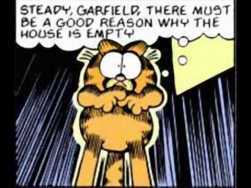 I remember reading this series of comic strips during a week in October when I was around 10 or 11, and it was a harrowing experience to say the least. For a comic that had had a consistent style and premise, both of which revolved around the life and antics of a surly, lazy cat and his companions, this abrupt shift in tone and mood was unsettling from the get-go. The premise, that Garfield was in fact a lonely, starving cat who lived in a dilapidated and crumbling house, and that his actions with Jon and Odie in the warm, well-kept abode readers had come to know are merely the self-delusions of an individual suffering from starvation and extreme denial, left an indelible mark on my appreciation for Jim Davis to tell a good horror story when he wanted to.There’s an
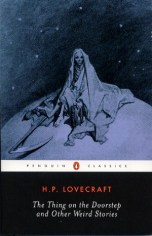 This isn’t the most famous of HP Lovecraft’s stories, and certainly suffers at times from his tendency to over-verbalize, but this first exposure to his works instilled in me both a love for the writer and a visceral sense of terror at this story’s premise. It mostly comes down to the central premise about the story being about possession, and the extremes of one particular entity’s willingness to take over the bodies of others, but there are other elements and themes of this story that creep me out as well. That this little gem of a horror story both begins and ends with the author’s imprisonment in a mental facility leaves the reader more than a little discomfited at the entire experience, which is exactly how you should feel when reading Lovecraft. Well done, Mr. Lovecraft. Well done.
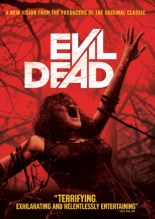 In the last decade or so, there have been a slew of remakes of old horror films that have really driven home the scares. Not that the originals aren’t perfectly hair-raising on their own–I can recall more than a few of them keeping me up at night–but the sheer level of visceral terror involved in such films as Rob Zombie’s 2007 remake of Halloween and Fede Alvarez’s 2013 reimagining of The Evil Dead just make it seem like the creators were really out to get moviegoers. There’s also no doubt that with the advances in movie effects, films such as these are ripe for an upgrade.
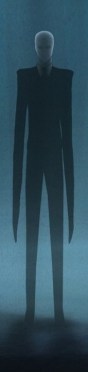 I pretty much couldn’t close out this list without mentioning Slenderman (a.k.a. the Slender Man), whose emergence onto the internet and into the collective consciousness of a generation has been both fascinating and horrifying to behold. The unnaturally tall, thin, blanked-faced character dressed in a black suit tends to stalk, abduct, and otherwise traumatize people, disrupting video feeds and often causing others to disappear without a trace. Having only graced the internet with his presence since 2009, Slenderman is a very new phenomenon that demonstrates just how powerful a well-conceptualized image and premise can be online.It’s Slenderman’s fame in particular that intrigues me, as he’s basically gone from a nonexistent thing that has no influence on the world to a nonexistent thing that now exists very strongly in the minds of others, and who very arguably influences the world in which he doesn’t exist, fitting the definition of an egregore. This is very evident not only in the number of stories, creepypastas, artworks, video games, and other multimedia in which the character continues to pop up, but also in the unfortunate
 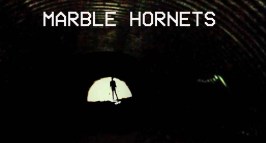 Closely related to Slenderman is the web series
  Spidey Librarian