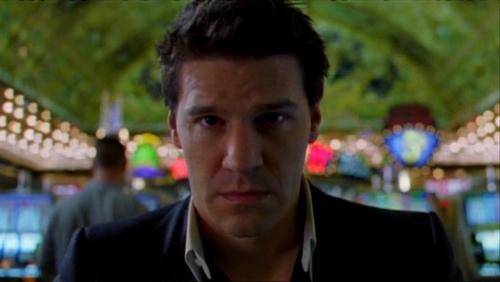
Angel, like Buffy the Vampire Slayer, as well as so many other good shows throughout television history, still occasionally suffered from the odd episode that was clearly filler and failed to really connect with fans. “The House Always Wins,” the third episode of season 4, was one such installment, but it has one particular plot device that still speaks to me today, which I feel somewhat redeems what is generally regarded as an uneven, bland episode.
The Spin-and-Win, a gambling wheel rigged by the episode’s villain, the casino owner Lee DeMarco, is only accessible by guests chosen by the casino. DeMarco uses Lorne’s ability to read people’s auras and see their futures, and with this information, chooses the ones with the most profitable destinies. They are given a special gambling chip to play the Spin-and-Win, with a million-dollar prize as the lure. When his mark takes the chip, it is imprinted with that person’s future destiny, and when they inevitably lose, they are left virtually mindless, their destiny taken away along with their ambition, and they spend the rest of their lives in a dull haze, listlessly spinning away quarters in the casino’s slot machine.
Most fans feel this is a pretty heavy handed attempt to equate gambling with throwing away one’s future, and while that’s not a completely off-kilter supposition, it’s one I never really connected with gambling in spite of the context. The Spin-and-Win, along with its devious ‘destiny chip’ component, may have existed in a casino, and been in the purview of gamblers and those who loved games of chance, but to me the symbolism went a lot deeper. The trap that the Spin-and-Win represented could take any form, and entrap just about anyone, as long as they obsessed enough about it.
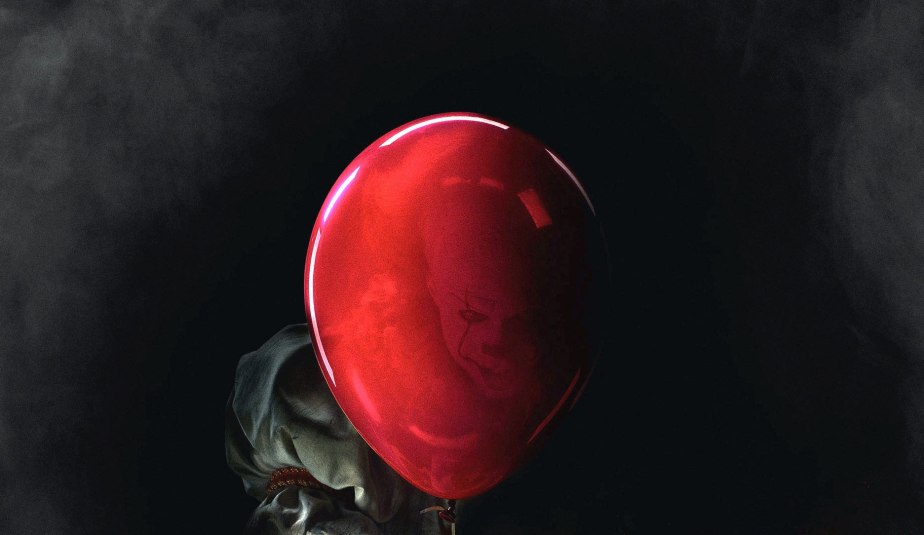
Yesterday I wrote about creation vs. consumption, and how Stephen King’s It both represented that struggle and how it’s helped inspire me to throw off (at least for now) the trappings of consumption so I can create. The image of this thing, the Spin-and-Win, from this episode of Angel, was another of the primary motivators that came to my mind’s eye as I came to this realization. The Spin-and-Win, in my estimation, could be anything to anyone, much like It could take on the form of anything that its victims feared. It wasn’t just about gambling, although I suppose my vice of gaming could easily be argued to have many parallels to that pastime.
For me, the Spin-and-Win represents video games. For someone who loves food too much, the Spin-and-Win represents food. For others, it could be sex, alcohol, television, movies, music. More broadly, the Spin-and-Win represent excess, the overindulgence of an otherwise harmless vice that creeps into your life and steals from you. Time, energy, devotion to otherwise creative or self-improving pursuits. It’s an easy retreat into something that’s comforting, but otherwise and ultimately, pointless.
I admit, “The House Always Wins” is not a great episode of Angel, though I still enjoyed it just fine. But the idea of someone throwing away their destiny because they see an easy (but rigged and unattainable) win in front of them is a powerful one that has stuck with me through the years. It’s always been there, in the back of my thoughts, and I’ve at times wondered why that particular form of that vice stuck when there have certainly been others that may have been more apt.
Now I know why, and I’m sending up that image to pull free of my own tendency to put of creating–writing–with something easy to consume–in this case, video games.
It may not be the prettiest or most eloquent way to break free, but so far it seems to be working out well for me.

 At any rate, as the doubtless imaginative title of this post suggests, I’m all full of New Year cheer, and eager to get underway with my resolutions. All the more remarkable about it is the fact that, by and large, I don’t formally make resolutions, at least not during New Year season, as I find them arbitrary, trite setups for failure that can really be made at any point during a given year with equal importance. And I’d say that’s still a relevant attitude I sport towards them in general, so it’s fair to say that I’m not going to be making any new resolutions for the coming year.
 Happy 2017, and may it be a great year for us all! Now, let’s get this ball rolling, and knock it out of the park as best we can.
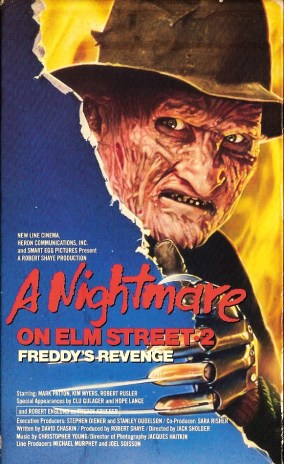 I don’t think it helps that my first exposure to these films was A Nightmare on Elm Street 2: Freddy’s Revenge, where Freddy seemed particularly more vicious than I’d see in the later films (though the first classic one was also a pretty good horror film on its own thanks to Robert Englund’s performance). Not only was he killing people in their dreams once they fell asleep–a terrifying enough premise all on its own–but he was also possessing one particular teen-aged character once he fell asleep in order to do it. In any case, the terrifying, claw-gloved antagonist of this series would go a long way in making sure I resisted the urge to fall asleep as much as possible for many years. It probably helps explain why I’m such an effortless night-owl by default.I’d thought I wouldn’t be able to take Freddy seriously when they made him more of a clownish killer in the later Nightmare movies, but Wes Craven’s Final Nightmare did a good job of establishing how and why this character existed, and temporarily renewed my interest in him. I wish they would have explored that when they rebooted by series a few years ago, but unfortunately they didn’t, and I was left wanting for another good Nightmare film. Hopefully someday, someone with the right skills can come along and make Freddy frightening again.
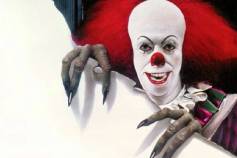 This film, along with honorable mention Poltergeist, is no doubt responsible for more than a few people’s irrational fear of clowns, though I myself never succumbed to this. And with Tim Curry’s simultaneously comical and vicious portrayal of the character (or rather, the main physical manifestation of said character), it became one of the movies that came quickest to mind whenever I thought about things that scared me. A creepy… no, scratch that–terrifying clown, who you couldn’t even really kill, and who could psychically torment you across distances? A monster in disguise made to lure children to their doom? Yep, I’m pretty sure that’s pure, unadulterated nightmare fuel.
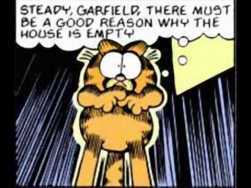 I remember reading this series of comic strips during a week in October when I was around 10 or 11, and it was a harrowing experience to say the least. For a comic that had had a consistent style and premise, both of which revolved around the life and antics of a surly, lazy cat and his companions, this abrupt shift in tone and mood was unsettling from the get-go. The premise, that Garfield was in fact a lonely, starving cat who lived in a dilapidated and crumbling house, and that his actions with Jon and Odie in the warm, well-kept abode readers had come to know are merely the self-delusions of an individual suffering from starvation and extreme denial, left an indelible mark on my appreciation for Jim Davis to tell a good horror story when he wanted to.There’s an
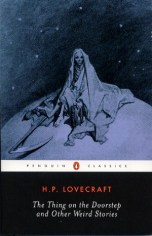 This isn’t the most famous of HP Lovecraft’s stories, and certainly suffers at times from his tendency to over-verbalize, but this first exposure to his works instilled in me both a love for the writer and a visceral sense of terror at this story’s premise. It mostly comes down to the central premise about the story being about possession, and the extremes of one particular entity’s willingness to take over the bodies of others, but there are other elements and themes of this story that creep me out as well. That this little gem of a horror story both begins and ends with the author’s imprisonment in a mental facility leaves the reader more than a little discomfited at the entire experience, which is exactly how you should feel when reading Lovecraft. Well done, Mr. Lovecraft. Well done.
 In the last decade or so, there have been a slew of remakes of old horror films that have really driven home the scares. Not that the originals aren’t perfectly hair-raising on their own–I can recall more than a few of them keeping me up at night–but the sheer level of visceral terror involved in such films as Rob Zombie’s 2007 remake of Halloween and Fede Alvarez’s 2013 reimagining of The Evil Dead just make it seem like the creators were really out to get moviegoers. There’s also no doubt that with the advances in movie effects, films such as these are ripe for an upgrade.
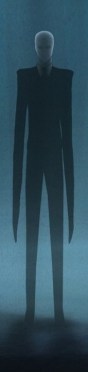 I pretty much couldn’t close out this list without mentioning Slenderman (a.k.a. the Slender Man), whose emergence onto the internet and into the collective consciousness of a generation has been both fascinating and horrifying to behold. The unnaturally tall, thin, blanked-faced character dressed in a black suit tends to stalk, abduct, and otherwise traumatize people, disrupting video feeds and often causing others to disappear without a trace. Having only graced the internet with his presence since 2009, Slenderman is a very new phenomenon that demonstrates just how powerful a well-conceptualized image and premise can be online.It’s Slenderman’s fame in particular that intrigues me, as he’s basically gone from a nonexistent thing that has no influence on the world to a nonexistent thing that now exists very strongly in the minds of others, and who very arguably influences the world in which he doesn’t exist, fitting the definition of an egregore. This is very evident not only in the number of stories, creepypastas, artworks, video games, and other multimedia in which the character continues to pop up, but also in the unfortunate
  Closely related to Slenderman is the web series
  Spidey Librarian